
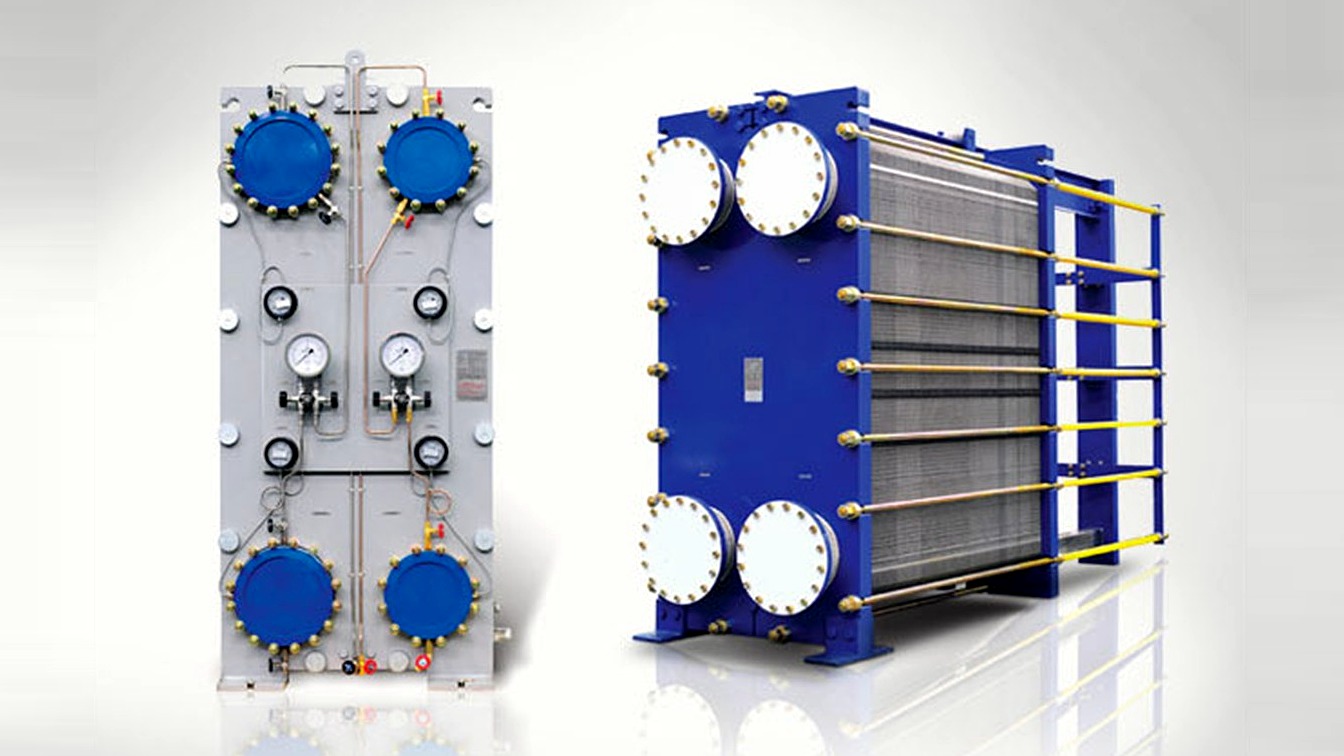
Aqua Logistics is DHP Engineering’s representative for South-East Asia, working out of Singapore. DHP builds gasketed plate heat exchangers for marine, offshore and shore plant — central cooling, jacket water, lubricating oil, fuel heating and HVAC. The two units above are the marine type, frame-mounted with its gauges and valves made up, and the plant type, supplied as a bare frame.
How it works
A plate heat exchanger is a stack of corrugated plates held between a fixed frame and a movable frame by tightening bolts. Hot and cold fluid pass through alternate channels between the plates and exchange heat through the plate wall; a gasket around each plate seals the channels from one another and sets the direction of flow. The cold fluid runs upward and the hot fluid downward, which keeps the temperature difference across the plate as high as possible along the whole length.
Connections are normally all in the fixed frame, so the movable frame can be pulled back without breaking any pipework. On a multi-pass arrangement some connections have to sit in the movable frame as well.
Pass arrangements
| Single pass | True counter-flow with every nozzle on the fixed frame. Only the movable frame has to be pulled to open the unit, so cleaning is quick and plates can be added or removed to change capacity without touching the pipework. The usual marine choice. |
|---|---|
| Single and multi pass | Where the inlet and outlet temperatures, or the allowable pressure drop, differ sharply between the two sides. Running one side single pass and the other multi pass raises the overall heat transfer coefficient. |
| Multi pass | Both sides multi pass. Worth it where the flow rate is low relative to the heat duty and the fluid is clean; it lifts heat transfer substantially, but the nozzle pipework on the movable frame has to be altered if the unit is later extended. |
| Multi-multi pass | A separator frame lets one unit handle three or more fluids. Mainly a food-industry arrangement, used for sterilisers. |
The gasket
The gasket is where a plate heat exchanger usually fails, and it is what DHP has concentrated on.
- The Perfect Seal gasket uses a three-dimensional pressure dispersion profile. DHP holds international patents on it in 28 countries.
- It develops roughly three times the friction force of a conventional gasket in the groove, which holds the plate pack tight and, on DHP’s figures, takes the unit to 50 bar.
- Gaskets are adhesive-free — seated in the groove and held by pressed indentations, so a set can be changed on board without glue or curing time.
- In the port area the two fluids are separated by double gaskets with a leakage gap between them. If a gasket does let go, the fluid vents to atmosphere where it can be seen rather than crossing into the other circuit.
Supply and spares
We supply DHP units against a duty specification and hold the wearing parts — plates and gasket sets — for the models we have on the water. Send the flow rates, the inlet and outlet temperatures, the fluids and the allowable pressure drop on each side, and we will size a unit and come back with a quotation.