

Coltraco Ultrasonics has been building ultrasonic instruments in Britain since 1987 and exports to 120 countries. The instruments here all do one job: they read the liquid level inside a sealed cylinder or tank from the outside, without opening it, disconnecting it or taking it off line.
On this page
- Why measure from outside›
- The Portalevel range›
- Hazardous areas›
- Portatank for tanks›
- Portasteele CALCULATOR›
- Portascanner leak testing›
- What the rules ask for›
Why measure from outside
A fire suppression cylinder has to be checked for content at every survey. The traditional method is to disconnect it and weigh it — which means the system is out of service while you do it, the cylinder is handled with a live charge in it, and a full engine-room bank can take a day.
An ultrasonic level indicator puts a sensor against the outside wall and reads the gas/liquid boundary through the steel. The cylinder stays connected and charged, one operator can do it, and a reading takes under 30 seconds.
The Portalevel range
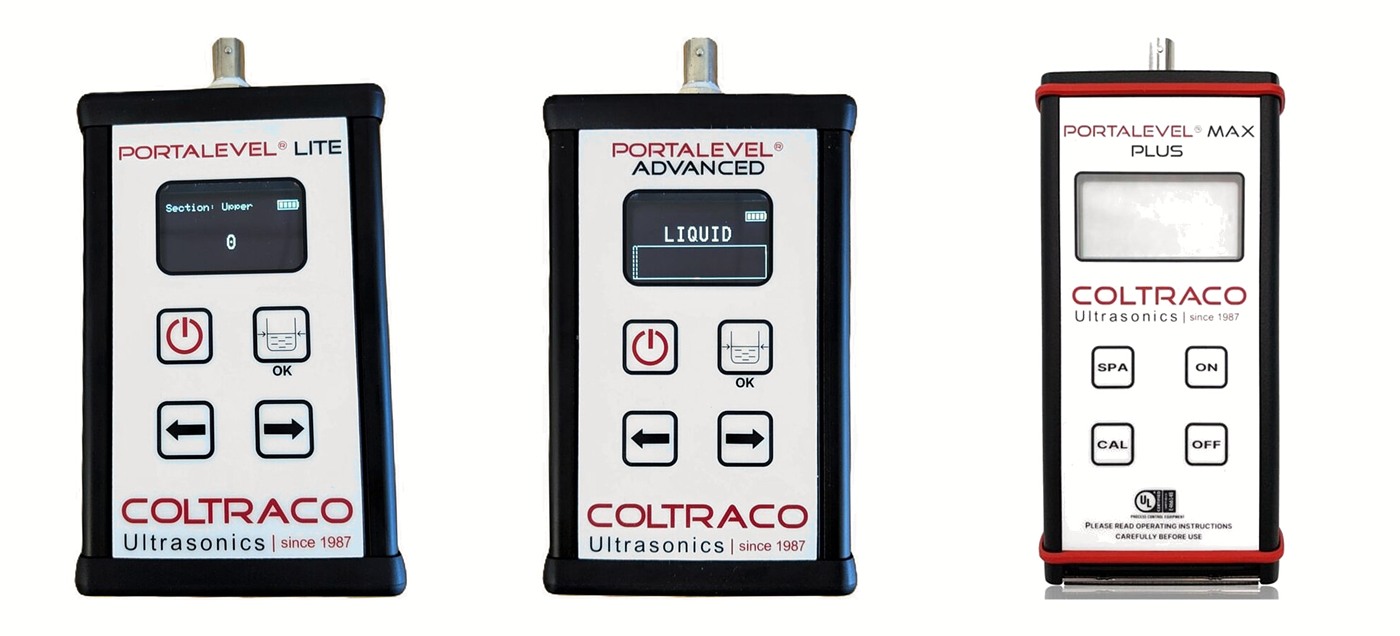
| Model | Accuracy | Cylinder diameter | Approvals | Chosen for |
|---|---|---|---|---|
| Portalevel® LITE | ±1% of true level | 110 – 406 mm | CE, UKCA | Entry level. OLED GAS / LIQUID display, 24 hours on AAA cells. |
| Portalevel® ADVANCED | ±1% of true level | 110 – 700 mm | CE, UKCA | Built-in signal viewer — an oscilloscope trace of the return, so you can see the phase change rather than infer it. Widest cylinder range. |
| Portalevel® MAX PLUS | ±1.5 mm | Most single-skin cylinders | UL listed, RINA | The flagship. IP65, backlit LCD, three calibration modes and four power settings. |
| Portalevel® MAX MARINE PLUS | ±1.5 mm | Most single-skin cylinders | UL listed, RINA, ABS Type Approval | The marine unit. Adds a 0.9 m extension rod so banked cylinders can be read without breaking the bank apart. |
| Portalevel® IS | ±1.5 mm | Most single-skin cylinders | ATEX II 2 G Ex ib IIA T4 Gb, IECEx | Zone 1 and Zone 2. See below. |
All of them measure the same agents — CO₂, FM-200™, NOVEC™ 1230, FE-13™, FE-25™, NAF S III™ and the Halons — and all ship as a kit: main unit, ultrasonic sensor, couplant, infrared thermometer for cylinder surface temperature, calibration certificate and a hard case. Main unit warranty is three years, sensor one year, technical support for the life of the unit.

Hazardous areas
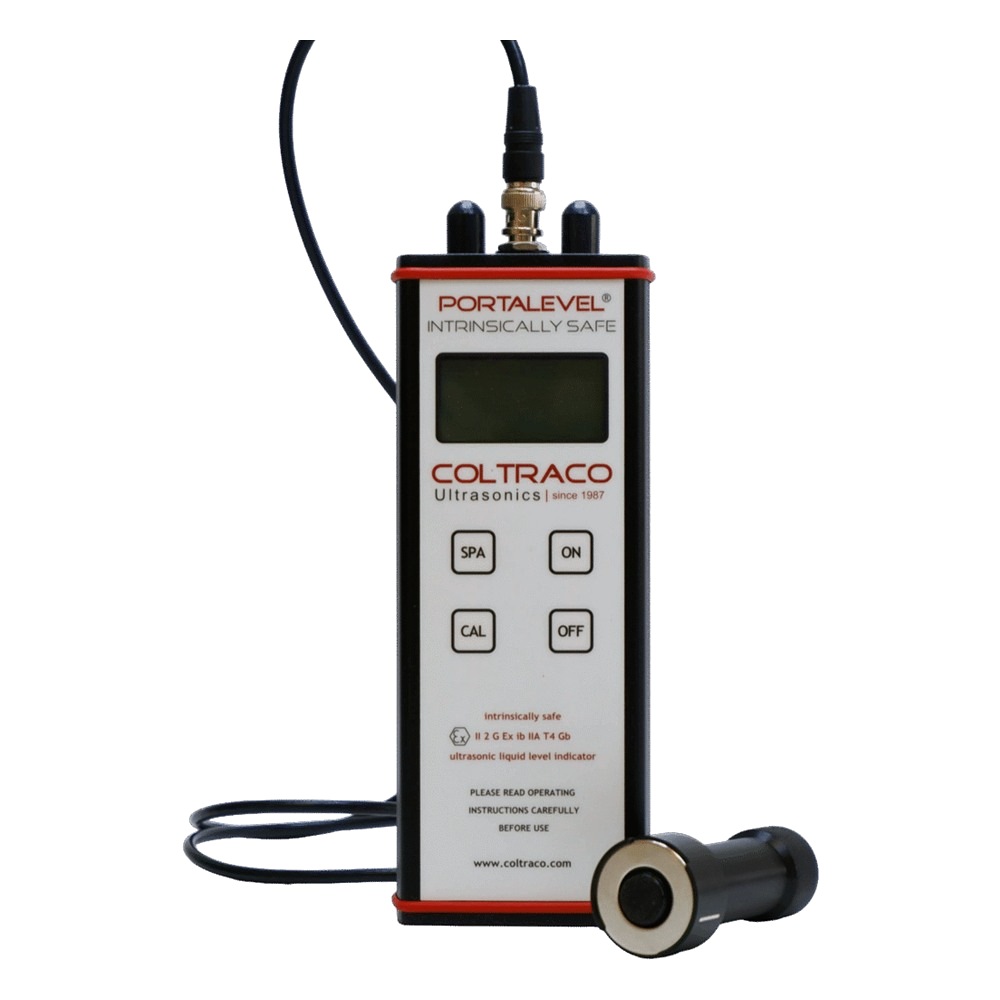
The Portalevel® INTRINSICALLY SAFE is certified ATEX II 2 G Ex ib IIA T4 Gb and IECEx Ex ib IIA T4 Gb for Zone 1 and Zone 2 — LNG and LPG carriers, oil tankers, offshore platforms handling flammable gas, and chemical and gas plant. It removes the need for a hot work permit to inspect the fire suppression system.
Meeting the ATEX power limit means a weaker transmitted signal, so the unit compensates with three calibration modes including an intelligent mode, and four power settings for larger or corroded cylinders. Accuracy stays at ±1.5 mm. Standards certified are EN IEC 60079-0:2018 with IEC 60079-11:2023 for ATEX, and IEC 60079-0:2017 with IEC 60079-11:2023 for IECEx.
Operating temperature is −20 to +40 °C, narrower than the rest of the range. Only the supplied Energizer L91 AA cells keep the ATEX approval valid — two sets come with the unit. The infrared thermometer in the kit is not intrinsically safe and must not be taken into the zone.
Portatank for tanks

Portatank® does the same trick on bulk tanks rather than cylinders — water, fuels, oils, coolants and clean liquids, in tanks from 0.5 to over 15 metres across, to ±10 mm. It works through most metals, plastics and glass, provided the wall is single-skinned.
Its usual job is checking the gauge you already have. Float mechanisms stick and read the wrong level; sight glasses go cloudy. Portatank verifies both from outside without opening anything. The other common use is oil level in transformers, switchgear and ring main units, where a dipstick means opening a live tank.
| Working range | 0.5 m to 15 m+ tank diameter |
|---|---|
| Accuracy | ±10 mm |
| Sensor | 25 mm 500 kHz standard; 200 kHz, 1 MHz and 2 MHz options |
| Wall | Single-skinned — most metals, plastics and glass |
| Temperature | −20 to +70 °C |
| Power | 4 × AA, 6 hours continuous |
Portasteele CALCULATOR
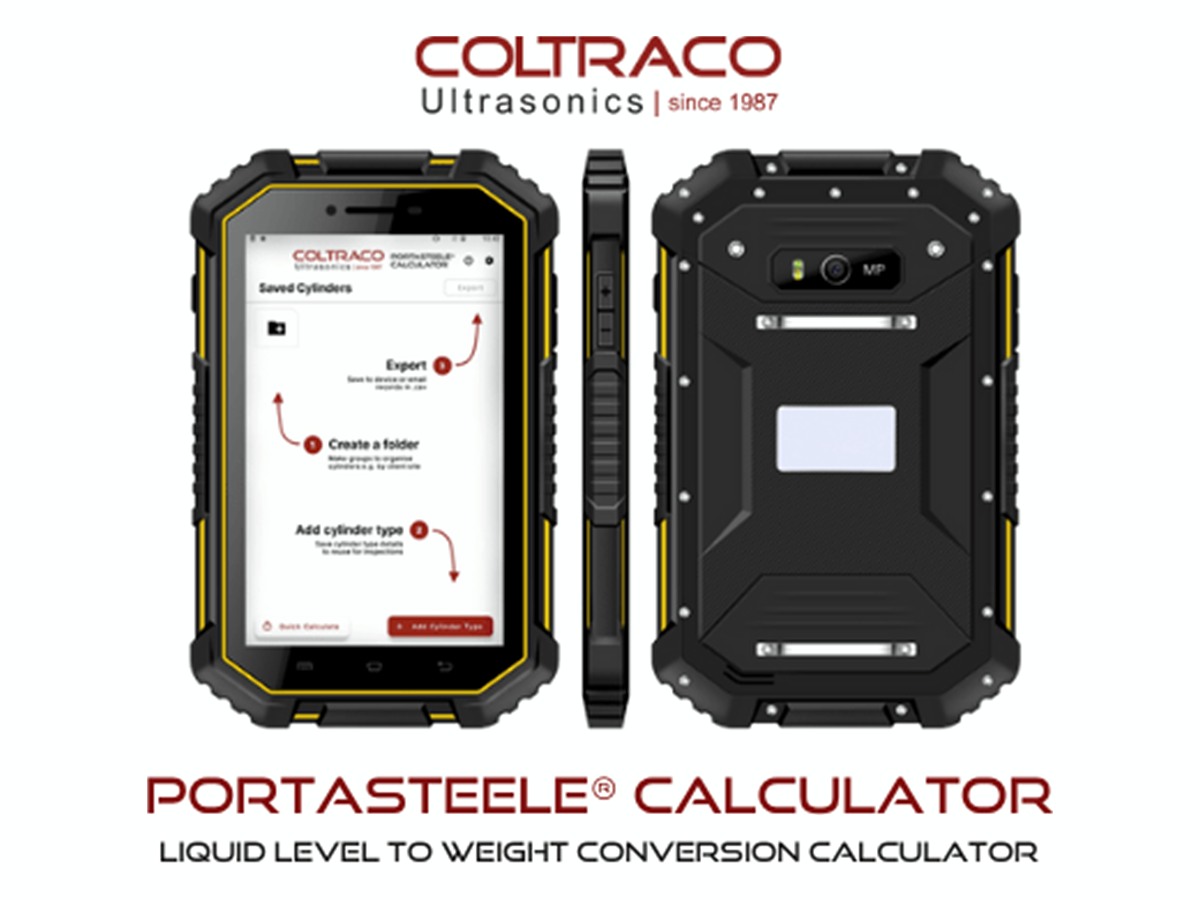
There is a gap between what a level indicator gives you and what the paperwork asks for. The cylinder label states a fill weight; the meter gives you a level. And the level moves with temperature, by a different amount for every agent and cylinder size.
Portasteele® CALCULATOR closes that gap. You give it the cylinder dimensions and the level from the Portalevel, and it returns the agent weight to within 1% of true, correcting for temperature automatically. Every measurement is saved with a time and date stamp, and exports to USB for the inspection report.
It also refuses to record what it cannot measure honestly. Agents such as CO₂ and FE-13™ pass their critical point within normal ambient temperatures — above 31 °C for CO₂ there is no liquid layer left to find. Enter a temperature above that and the calculator returns an error rather than a number.
It runs on a rugged 7-inch IP67 tablet with a rechargeable battery, and covers CO₂, FM-200®, NOVEC™ 1230, Halon 1211 and 1301, FE-13™ and FE-25™, on welded and seamless cylinders.
Portascanner: leak and integrity testing

Same physics, different job. A generator inside the compartment fills it with 40 kHz ultrasound; an operator outside runs a wand along the seal. Wherever sound gets through, so can water or air — and the reading tells you how big the gap is. All four models find leaks down to 0.06 mm ± 0.02 mm.
For hatch covers this matters commercially: ultrasonic testing is the method P&I clubs recognise for weathertightness, and a cover passes at an Open Hatch Value below 10%, calculated to DNVGL-CP-0484 and IACS UR Z17. It also replaces the chalk and hose tests for the weekly watertight door inspection under SOLAS Reg II-1/21.3 — one operator, no water, and a number at the end rather than an opinion.
| Model | For | Reads | Notes |
|---|---|---|---|
| Portascanner® WATERTIGHT PLUS | Hatch covers, watertight doors, multi-cable transit seals | Decibels, linear, or % Open Hatch Value | ABS Type Approved, RINA accepted. Handheld, 10 hours on a PP3 cell, −20 to +70 °C. |
| Portascanner® WATERTIGHT PRO | The same, where the result has to be recorded | Flow rate per leak and for the whole hatch; ±10% on 0.5–20 mm | 7-inch touchscreen. Photograph the hatch, plot each leak on the picture, export the record to USB. IP65. |
| Portascanner® AIRTIGHT | Compartment and building airtightness | Quantifies leaks from 0.5 mm; totals them as air changes per hour | Camera and reporting on the device. Used before, during and after a door fan or pulse test. |
| Portascanner® | Room integrity — server rooms, clean rooms, gaseous-agent enclosures | Audio and digital readout | The original. Used to find and seal leaks so an enclosure passes its door fan test first time, as required for NFPA 2001 rooms. |
The watertight models are the marine pair; AIRTIGHT and the original Portascanner are building and enclosure instruments, useful where a gaseous fire-suppression room has to hold its agent.
What the rules ask for
Non-invasive ultrasonic level measurement is an accepted method of verifying clean-agent quantity at the periodic inspection. The regimes that apply to our customers are:
- IMO SOLAS FSS Code Chapter 5, and MSC.1/Circ.1318 for CO₂ systems
- NFPA 12 (carbon dioxide), NFPA 12A (Halon 1301) and NFPA 2001 (clean agent)
- ISO 6183 (carbon dioxide) and ISO 14520 (gaseous fire-extinguishing systems)
- SOLAS Reg II-1/21.3 for weekly watertight door inspection, with IACS UR Z17 and DNVGL-CP-0484 behind the Open Hatch Value calculation
Where the report has to state an agent weight rather than a level, the Portalevel and Portasteele are used together — the level alone is not what the standard asks you to record.
We supply, calibrate and support the range from Singapore, and can train your crew or service team on the instrument.