
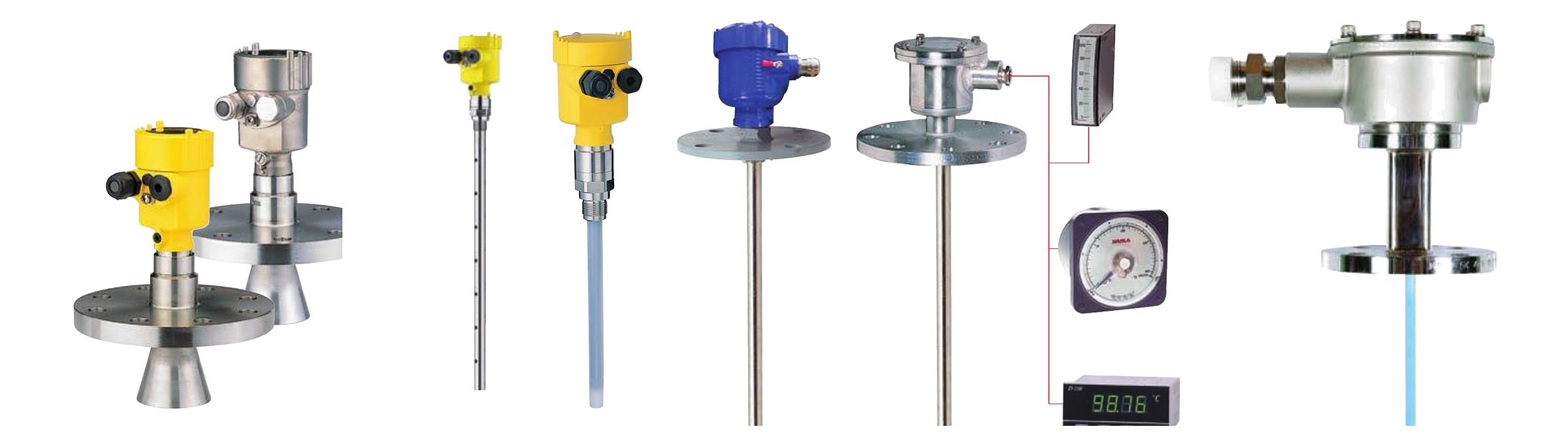
Continuous level measurement for cargo, ballast and service tanks — non-contact and guided radar, capacitive probes, magnetic float transmitters and submersible pressure transducers. All give a 4–20 mA output that feeds an indicator, a cargo display or a loading computer.
On this page
- Microwave (radar) type level transmitter›
- Capacitive level measurement›
- Magnetic float type level transmitter›
- Electric pressure type level transmitter›
- Choosing a transmitter›
Microwave (radar) type level transmitter
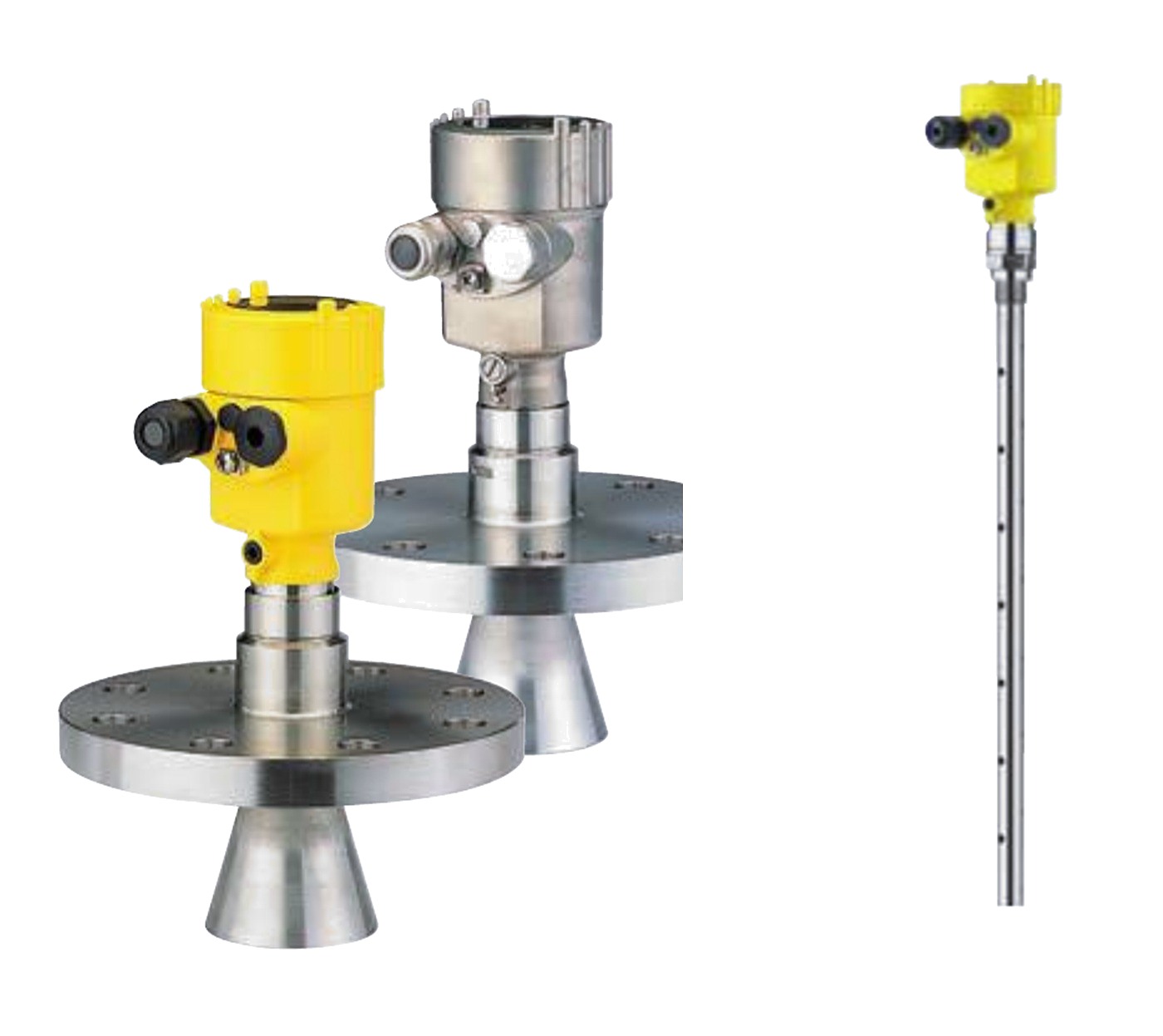
Model: VEGAPULS series. Free-space radar in two-wire technology — supply and 4–20 mA analogue or digital signal share the same pair, and up to fifteen sensors can run on one two-core line. The advantage over every mechanical method on this page is that the reading is independent of pressure, temperature, density and gas composition, and there is nothing to age or wear.
The sensors are Ex-approved, with small housing dimensions, 1-1/2″ or DN 50 process connections, an integrated analogue and digital display, and connection to all BUS systems. Setting up is done from a detachable card-sized adjustment module, a HART handheld, or a self-explanatory program on a PC — on the signal line, at the sensor, in the switch cabinet, or from the DCS.
The materials are resistant, and the range covers waste water and disposal, chemicals, foodstuffs, metal treatment and generation, automobile industry, power generation and transport, process technology, shipbuilding, recycling, pharmaceuticals, mining and offshore.
| Model | Application | Measuring range | Process temperature | Process pressure | Accuracy |
|---|---|---|---|---|---|
| PULS 61 | Aggressive liquids in small vessels under easy process conditions | up to 35 m | −40 to 80 °C | −1 to 3 bar | ±2 mm |
| PULS 62 | Storage and process vessels under arduous process conditions | up to 35 m | −200 to 450 °C | −1 to 160 bar | ±2 mm |
| PULS 63 | Aggressive liquids under arduous process conditions | up to 35 m | −200 to 200 °C | −1 to 16 bar | ±2 mm |
| PULS 65 | Aggressive liquids under easy process conditions | up to 35 m | −40 to 150 °C | −1 to 16 bar | ±8 mm |
| PULS 66 | Storage and process vessels under arduous process conditions | up to 35 m | −60 to 400 °C | −1 to 160 bar | ±8 mm |
| PULS 68 | Large solid vessels under arduous process conditions | up to 75 m | −200 to 450 °C | −1 to 160 bar | ±2 mm |
VEGAFLEX series is the guided version. High-frequency microwave pulses are coupled onto a cable or rod probe and travel along it; the pulses reflect from the product surface and are evaluated by ECHOFOX software in the sensor. Because the probe guides the pulse, no adjustment to the medium is needed — the sensor arrives preset to the ordered probe length, and cable and rod versions can be shortened on site to suit the tank.
| Application | Liquids and solids |
|---|---|
| Measuring range | Cable up to 32 m |
| Process temperature | −40 to 150 °C (max. −100 to 400 °C) |
| Process pressure | −1 to 40 bar (max. −1 to 160 bar) |
Capacitive level measurement
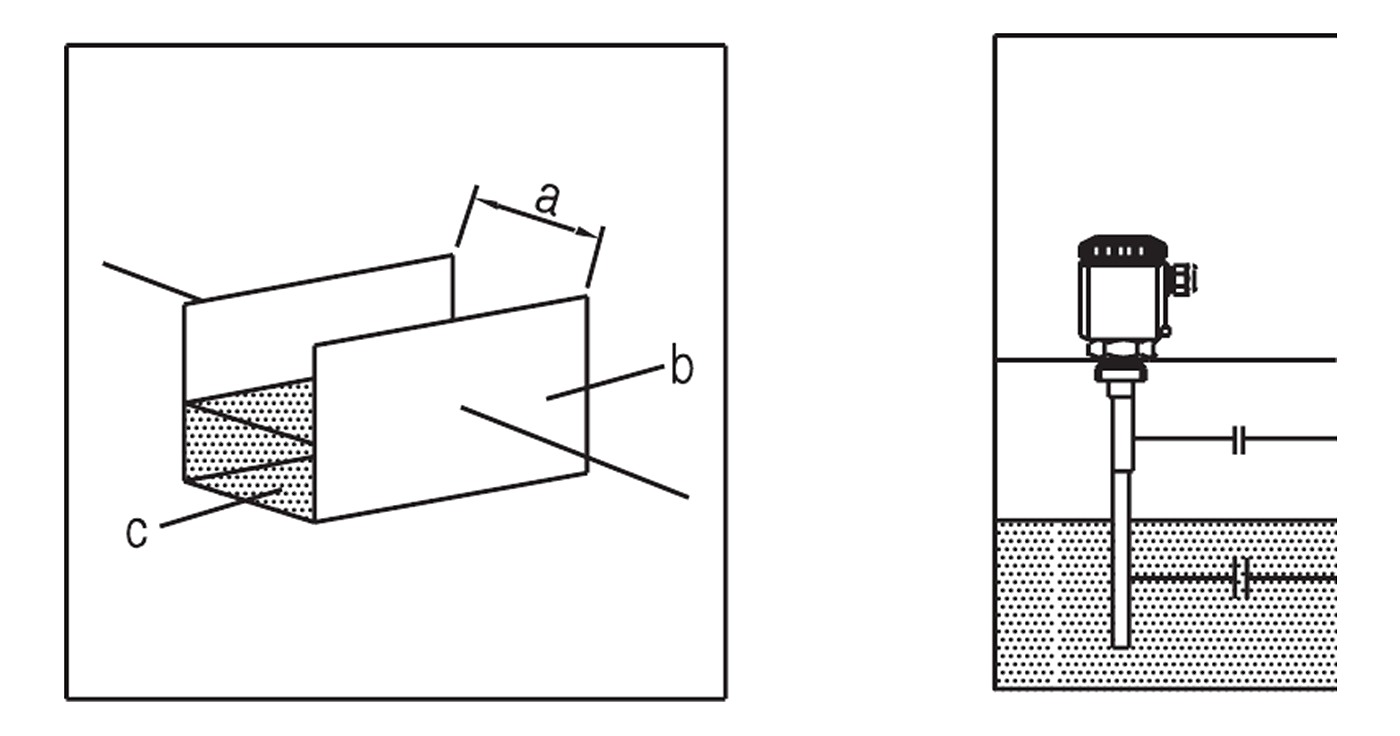
Model: VEGACAL series. The electrode and the vessel wall form an electrical capacitor. Its capacitance depends on three things: the distance between the plates, the area of the plates, and the dielectric value of the material between them. The product is the dielectric, and because its dielectric constant is higher than that of air, the capacitance rises as the electrode is covered.
An oscillator converts the capacitance change into a level-proportional floating current in the 4–20 mA range, or into a switching signal. For continuous measurement a VEGAMET signal-conditioning instrument converts the oscillator current into standard current and voltage signals, which can then go to indicating instruments, VEGASEL auxiliary level switches or any other processing system without further potential equalisation.
Continuous measurement needs a product with a constant dielectric constant and otherwise steady properties. The same electrode principle also serves point detection: for maximum or minimum level the switching signal can be triggered either when the electrode is covered or when it is uncovered, whichever the application calls for.
The electrodes detect virtually every product — liquids, powders, granules and pasty materials, including adhesive products.
Magnetic float type level transmitter

Model: FLT-100 series. Reed switches are arranged at a fixed pitch inside a guide pipe. A magnet in the float closes one or two of them at a time, and the detecting circuit becomes the electrical equivalent of a potentiometer. Because the magnet is sized so that never more than two switches operate together, the resolution comes out at half the reed pitch — a 10 mm pitch gives 5 mm resolution.
Accuracy for a given tank is set by choosing the reed pitch and the division number to suit the total measuring range, so it stays consistent regardless of tank depth. The construction is simple, service-proven and easy to maintain, needs only a single two-core cable, and drives analogue and digital indication as well as switching contacts at predetermined levels.
Used on water, heavy fuel oil, diesel oil, lubricating oil and vegetable oil.
| Connection size | JIS 5K 80A or 100A; JIS 5K 100A only with float chamber type |
|---|---|
| Max. pressure | 10 kg/cm² |
| Max. temperature | SUS 316 float 100 °C; resin float 70 °C; P.V.C float 60 °C |
| Min. specific gravity | SUS 316 float 0.85; resin float 0.6; P.V.C float 0.7 |
| Measuring range | Max. 5 m, option up to 30 m |
| Sensor resistance | About 1 kΩ |
| Max. current | 25 mA |
| Power source | 12 – 32 V DC |
| Output | 4 – 20 mA DC, two-wire balancing type |
| Cable entry | 15b |
| Enclosure | Weatherproof IP56 |
| Materials | Housing AC and SUS 304; flange carbon steel; float and guide pipe SUS 304 |
| Accuracy | ±1.5% of full scale |
Model code: FLT-100 – mounting (RT top, RI inside, RS side) – float size and material (S Ø65×111L SUS 304, R Ø50×45L resin, P Ø76×100L P.V.C, T teflon, SF special) – internal construction (G without float chamber, C with float chamber) – enclosure (W weatherproof IP56, E explosion proof IP56 / Exd IIC T6, I intrinsically safe Ex ia IIC T6 with I.S. barrier) – option (H 4–20 mA smart type HART).
Electric pressure type level transmitter
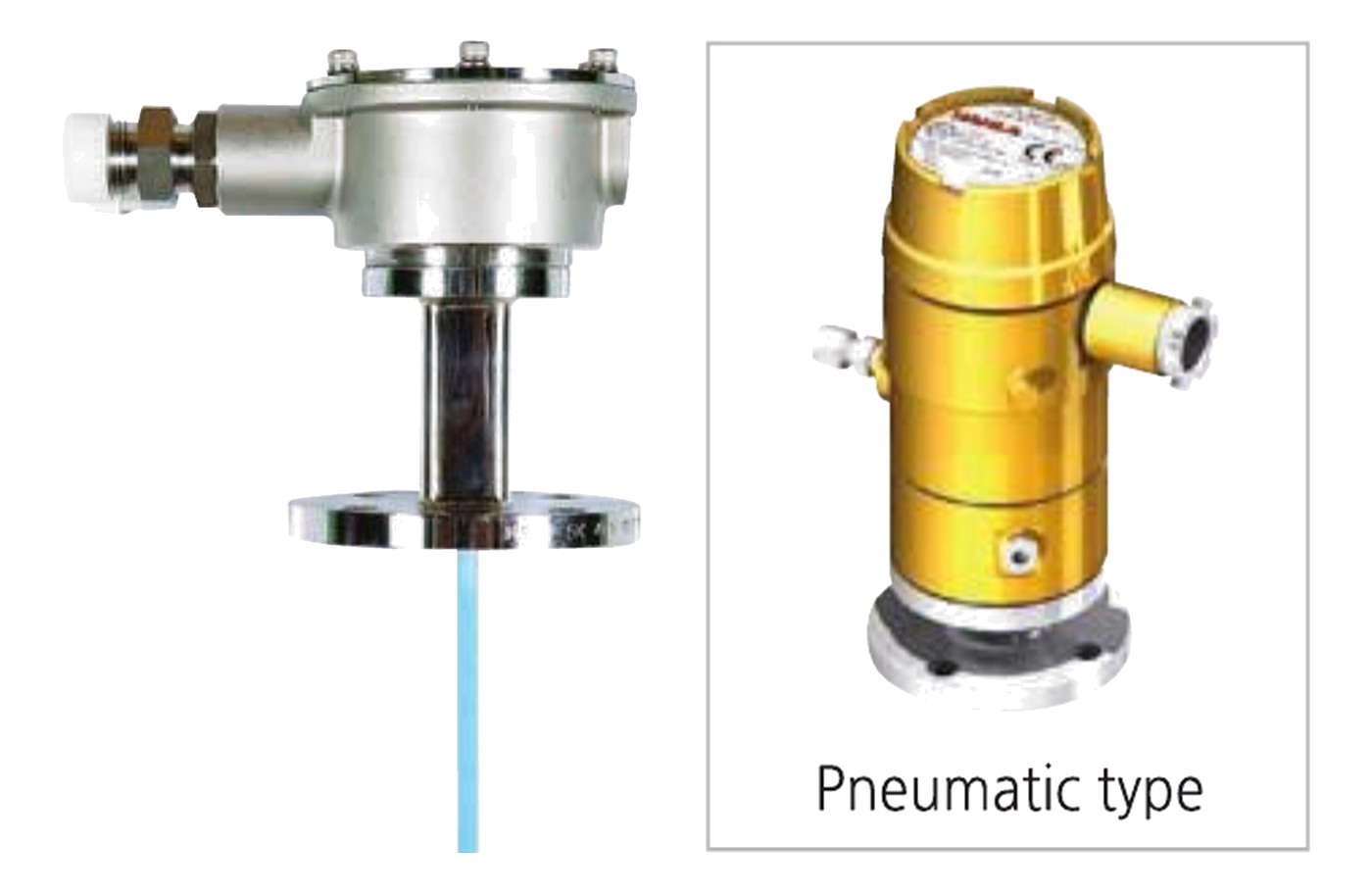
Model: PL-40. A two-wire 4–20 mA transmitter made of a submersible transducer and an amplifier joined by a vented cable. Pressure on the face of the diaphragm produces a capacitance change in the transducer cell, and the amplifier converts that change into the output signal.
This is the transmitter for ballast tank and draft remote reading, heeling and trim, fuel oil tank level, and waste water, wells, locks and rivers. It connects directly to a CRT cargo display system, a loading computer, an indicator or an analogue indicator, which is why it appears on most ballast and draft installations.
| Output | 4 – 20 mA, adjustable |
|---|---|
| Accuracy | ±0.2% F.S. at 20 °C |
| Supply voltage | 12 – 28 V DC |
| Range | Gauge 175 mbar to 4 bar; absolute 1,400 mbar to 4 bar |
| Overpressure | Gauge 6 bar to 25 bar; absolute 10 bar to 25 bar |
| Diaphragm cell | Capacitive transmitter with ceramic diaphragm |
| Materials | Diaphragm ceramic; sensor body stainless steel 316L; amplifier box SCS 13 indoor or SCS 14 outdoor; special cable sheathed polyethylene |
| Operating temperature | Transducer −40 to 125 °C; amplifier −25 to 85 °C |
| Protection class | Transducer IP68 submersible; amplifier IP66 |
| Intrinsic safety | Ex ia IIC T5, max. 50 m of cable between transducer and amplifier box |
| Cable length | 3 m standard, up to 50 m as an option |
Features: high measuring accuracy, excellent stability, capacitive transmitter with ceramic diaphragm, high overload limit, high temperature stability, corrosion resistance, no hysteresis, and marine class approval.
Model code: PL-40 – type (I inside mounting, O outside mounting, U utility, P pneumatic) – measuring range (0.1, 0.2, 0.4, 1, 2 or 4 bar). The catalogue lists this transmitter in its level switch section; it is a continuous transmitter and is set out here with the others.
Choosing a transmitter
| If you need | Use |
|---|---|
| A non-contact reading unaffected by density, vapour, pressure or temperature | VEGAPULS radar |
| A guided measurement on a difficult surface, or a long probe cut to the tank | VEGAFLEX |
| Powders, granules, pastes and adhesive products | VEGACAL capacitive |
| A simple, service-proven mechanical transmitter with alarm contacts on the same stem | FLT-100 magnetic float |
| Ballast and draft reading into a loading computer, with a submersible sensor | PL-40 pressure |
For direct reading at the tank, see level gauges. For point alarms only, see level switches. Where these transmitters feed a cargo console or an overfill alarm system, see tank monitoring systems.