Hanla IMS Co. Ltd. – Level Transmitters – Aqua Logistics Pte Ltd is the S.E.A. representative for Hanla IMS, based in Singapore, with extensive track records catering to various marine & offshore applications.
Hanla IMS – PL40 Series Level Transmitter
Hanla IMS Co. Ltd. – Electric Pressure Type – PL40
The Hanla Pressure Type Level Transmitter is for continuously measuring the liquid level of ballast tank, draft and fuel oil tank in the marine ships as well as tanks containing media.
The PL40 is a 2-wire, 4~20 mA level transmitter consisting of a transducer and an amplifier connected via a submersible vented cable.
Pressure change in the front of the diaphragm will bring about a capacitance change in the cell of the transducer. This change will be transmitted to amplifier as a change in the electrical signal. The PL40 is manufactured in several ranges, and can be used to connect to the C.R.T. display cargo system, loading computer, indicator and analog type indicator to measure the actual level.
Hanla IMS – Vega Series Level Transmitter
Hanla IMS Co. Ltd. – Microwave Type – VEGAPULS SERIES
Radar is a sophisticated level measuring principle. VEGA’s new design of small, compact and price favorable radar sensors put VEGAPULS as a market leader in the radar level measuring market.
The radar sensor in two-wire technology supply voltage and output signal (4~20mA analog or digital); connectable with max. 15 sensors on a two-core line.
VEGAPULS radar sensors offer benefits which meet the following technical requirements:
-Pressure and Temperature independant
-Ex-Approved
-Small housing dimensions and process connections ( 1 1/2″ or DN50 );
-Integrated analog and digital display
-Convenient connection form to all BUS systems
Radar technology can also be realized in low budget applications. The sensors are very informative and can be operated optionally with check card-sized and detachable adjustment module, HART handheld or operating program on PC. Thus, operation at any place, e.g. signal line, directly on the sensor, switch cabinet or DCS is possible.
Hanla IMS Co. Ltd. – Capacitive Type – VEGACAL SERIES
The product level is continuously monitored and converted into a level proportional signal which is either directly or further processed.
Applications – Liquid, Powder, Granule, Adhesive, etc.
Hanla IMS – FLT Series Level Transmitter
Hanla IMS Co. Ltd. – Magnetic Float Type
Continuous liquid level meter, display, with four separated adjustable alarm points, and output signal for remote level transmitter.
Applications – Measurement of Water, HFO, DO, LO and others.
Aqua Logistic is the S.E.A. representative for REMONTOWA HYDRAULlC SYSTEMS Sp. z o.o. – Electro-Hydraulic Watertight Sliding Doors (Previously known as Hydroster) based in Singapore, with extensive track record and door options to cater to all harsh offshore environments.
The main advantages are:
-compact design for fast and easy installation on board
-simple and resistant construction
-failure free drive system
-competitive pricing with high quality
-experienced technical support team
Max dimensions:
-clear opening height x width 2200 x 1200mm
-standard width 600, 800, 1000, 1100, 1200 other for request
Max load:
-Max load up to 25m water or cargo / passenger vessels applications.
-For offshore applications up to 50m water load.
Drive:
electro-hydraulic
Drive and control system enabling:
-remote closing door from bridge
-local closing, and opening door
-local closing and opening door by hand pump with both sides of bulkhead
-closing, opening, closing by accumulator energy (optionally)
-closing door by hand pump installed over bulkhead deck (optionally)
Time of closing the door by means of:
-power unit 20 = t = 40sec
-hand pump t = 90sec
Signaling:
-acoustic at the door
-optical at the door
-optical and acoustic on mimic panel for the bridge
-optical for stand over bulkhead deck
Class certificates:
G.L, DNV, L.R, B.V, ABS, RINA, RMRS, others as per request.
Bulkhead door-typical scope of delivery:
-door unit painted eproxy primer
-hand pump with tank, and panel indicator lights for installation above bulkhead deck (optionally),
-control block
-minic panel for installation on bridge
-spare parts
-documentation for shipyard in Auto Cad
-service manual
-class certificate
Optionally we offer:
-watertight door with low still,
-watertight doors A0 and /or A60 class
-watertight door with electric drive
Hanla IMS Co. Ltd. – Marine Level Gauge – Aqua Logistics Pte Ltd is the S.E.A. representative for Hanla IMS based in Singapore, with extensive track records catering to various marine & offshore applications. Hanla IMS’s liquid level gauges are suitable for various medium/fluids, including sea water, oil, sewage, etc,. Be it conventional flat type level gauges or high specification radar type level transmitters, we have got you covered.
Level Gauges
Hanla IMS – RLG Series Level Gauge
Hanla IMS Co. Ltd. – RLG Series -Flat Type Glass ( RLG-LP for Low Pressure and Temperature ) -Reflex Type Level Gauge ( RLG-HP for High Pressure and Temperature )
Application – Depending on Type: All water tanks, oil tanks and boiler drum etc.
Features: -Easy maintenance for RLG-LP Series – When required, the liquid chambers can be cleaned with the gauge on the tank. Alternatively with the use of the isolating valves, it is possible to remove the gauge without draining contents of the tank for maintenance.
Hanla IMS – FLG-F Series Level Gauge
Hanla IMS Co. Ltd. – FLG Series -Marine Float Type
Features:
-Economical Design -FLG-FCG type is gastight -Easy Reading -Easy Maintenance -Exact Indication -Easy Installation
Hanla IMS – FLG-M Series Level Gauge
Hanla IMS Co. Ltd. – FLG-MS -Magnetic Float Type Features: -High Visibility – Able to read even at great distances -Energy Efficient – Continuous level indication, without external power -Electronic Control – Attached optional point level switches and/or continuous level transmitter extend the capabilities beyond those of a simple sight glass replacement -Wide application – H.F.O., D.O., L.O., F.W., Petrochemical liquids
Hanla IMS – HB-SPCG Level Gauge
Hanla IMS Co. Ltd. – HB-SPCG Series
Self-Powered Content Gauge
Features:
No Floats
Completely Automatic
Local Indication
Customisable Scale Indication
Able to measure up to 50m Tank height
Full Mechanical Operation, Does not require external power
Hanla IMS – FW-DF Series Level Gauge
Hanla IMS Co. Ltd. – FW-DF Series -Dial Type Float
Features:
High Corrosion resistance, Safe and Easy to Maintain
Local Indication, with level switch and transmitter options available
Able to measure up to 6m Tank height
Side mount installation available
Full list of Type Approval certification from Various Classes are also available. Including : ABS, BV, DNV, GL, KR, LR, NK, RINA, Etc.
The International Maritime Organization (IMO) has adopted the International Convention for the Control and Management of Ships’ Ballast Water and Sediments, in order to regulate discharges of ballast water management system (BWMS) and minimize the risk of spreading harmful aquatic organisms by ship ballast water.
Hanla IMS Co. Ltd has developed eco-friendly EcoGuardian™ system for treating Aquatic Invasive Species in a ship’s ballast water treatment system (BWTS). Treatment’s method is side-Stream type which enables the system to be remotely installed away from the ballast lines. The EcoGuardian™ system can be installed separately by unit. So relocation of other equipment and additional engineering can be minimized.
Key Features of Eco Guardian – Ballast’s Water Management System (BWMS)
Ballast Water Treatment System – Overview
∙ Automatic back-flushing filter unit removes large organisms and solid particles above 50 μm
∙ Automatic back-flushing operation starts when the pressure difference between the water inlet and outlet reaches a certain value
∙ The side stream of the ballasting water goes through the electrolysis unit that generates the high concentration of TRO (Total Residual Oxidants). The concentrated stream is then injected back to the main ballasting line
∙ Electrolysis unit (including electrolytic cells, rectifier/transformer, booster pumps, conductivity sensor and degassing devices) produces sodium hypochlorite solution which disinfects the residual plankton, pathogens, larva or spores
∙ Neutralization unit adds sodium thiosulfate solution into the treated ballast water to neutralize the residual TRO during de-ballasting
∙ When ballasting maximum TRO concentration is limited to 9.0 mg/L
∙ When de-ballasting MADC (Maximum Allowable Discharge Concentration) is 0.2 mg/L TRO as Cl2
∙ Control system including PLC, HMI and auxiliary equipment
System General
The operation of HANLA EcoGuardianTM Ballast Water Treatments System (BWTS) can be divided into three phase :
-Ballasting -During voyage -De-ballasting.
Ballasting
Ballast Water Treatment System – Ballasting
During ballasting process, ballasting waters is first pumped through the automatic back flushing filter unit which removes large organisms and solid particles (>50μm). The filter unit is installed directly at the main ballasting line.
The side stream of the ballasting water goes through the electrochlorination unit that generates TRO of high concentration sodium hypochlorite which is then injected back to the main ballasting line. After injection, Sodium hypochlorite is mixed and diluted with main ballasting water and goes to ballast’s tanks. Maximum dose concentration is 9 mg/L TRO as Cl2 which is controlled by using the on-line TRO sensor. That is, EcoGuardian™ system adjusts the supplying current which determines hypochlorite production rate by monitoring TRO sensor.
Electrochlorination unit of EcoGuardian™ is designed to operate at the seawater salinity of 10 PSU or more. For operation in the low salinity water, EcoGuardian™ can use the seawater in the existing onboard seawater tank because this system use only small amount of seawater in comparison with the incoming ballast water flow (less than 5% of ballast’s water flow).
As a side reaction of electrochlorination, hydrogen gas is generated on the cathodes of cells. Because hydrogen gas is highly explosive, it should be properly vented from the system as soon as possible whenever it is produced. Hydrogen gas is separated by hydrogen separator and is diluted less than 1% of atmospheric concentration of hydrogen by forced air blowing. Finally this diluted hydrogen gas is vented to the outside of a ship. The lower explosive limit (LEL) for hydrogen is 4% and the fourfold safety of explosion limit is applied.
During voyage
The remained organisms in the ballast tank will be disinfected by the residual effect of disinfectants.
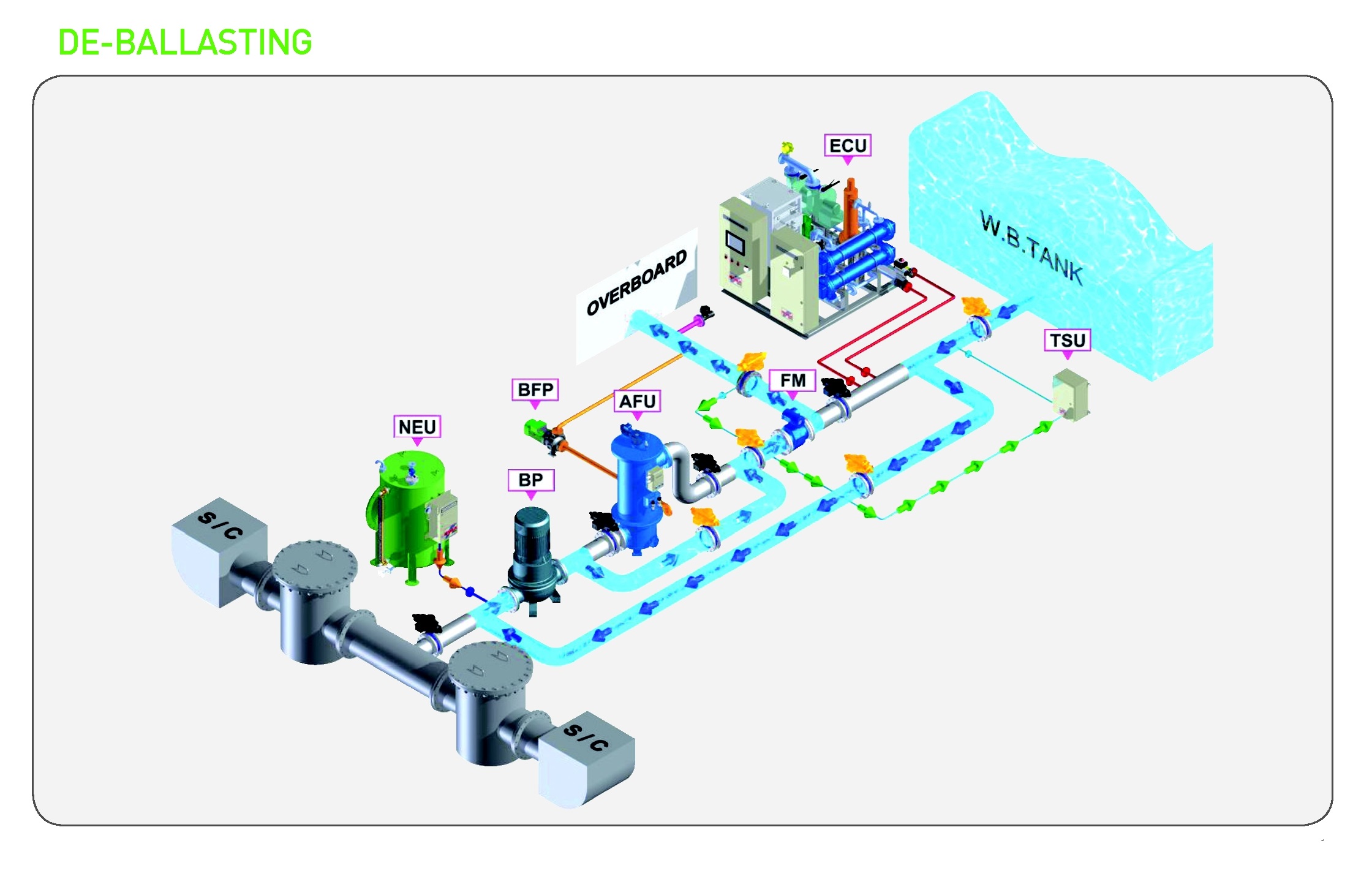
Ballast Water Treatment Systems (BWTS) by De-ballasting
Ballast Water Treatment Systems – Deballasting
During de-ballasting process, de-ballasting water passes through only neutralization unit prior to overboard discharging. As neutralizing agent, sodium thiosulfate is injected into de-ballasting line to neutralize the residual TRO. The injection amount of sodium thiosulfate is controlled by monitoring de-ballasting flow rate and residual TRO concentration.
Two TRO sensors are used to measure the residual TRO concentration at two points, before and after the neutralization unit. TRO measurement before the neutralization unit is used to measure the residual TRO concentration and then EcoGuardian™ Controller determines the injection amount of neutralizing agent into the de-ballasting line. Another TRO measurement after the neutralization unit is used to check that residual TRO has been neutralized properly.
Neutralization unit of EcoGuardian™ maintains Maximum Allowable Discharge Concentration (MADC) for 0.2 mg/L TRO as Cl2. To comply with this condition, dosing rate of sodium thiosulfate is set based on the stoichiometric ratio of TRO to sodium thiosulfate at 1:2 parts. Sodium thiosulfate is injected at the inlet Ballast’s Water treatment’s System pump so the residual TRO in de-ballasting water is rapidly neutralized by the mixing effect at ballast pump impeller.
When designing ship windows, several factors must be taken into consideration. Ship windows must meet strict safety and performance standards to ensure the safety of the crew and passengers onboard. This includes meeting requirements for visibility, impact resistance, and fire protection, as well as any specific regulations governing the use of certain materials or manufacturing techniques. As such, ship window production is highly specialized and requires advanced manufacturing equipment and techniques, as well as a deep understanding of the unique requirements and challenges of marine environments.
The BERGAFLEX Sunscreen system for sun and glare protection has been installed on a great number of ship bridges since the 1980s.
BERGAFLEX shades, based on metallised polyester film, are available in different colour combinations. They reduce solar energy by up to 90% and have a light transmission of between 2% and 13%.
Please contact us for further information regarding sun-screens or blackouts for map rooms and cabins on board.
The shading coefficient shows the amount of solar energy which ends up behind the arrangement, most often in the form of secondary radiation. The lower the value, the more effective the reflective arrangement. Still, a high-coefficient foil can be used to good effect if heat absorbed in the foil is ventilated away, which is the case if the foil is fitted to a self-ventilated window.
All values are based on ASHRAE-testing methods. This means, among other things, that the foil is fitted to the inside of 4-millimetre thick neutral glass.
Metallised Films
Ordinary water boils at 100°C at sea-level. At the top of Mount Everest where the air pressure is lower, however, water boils much quicker. In a vacuum (1/100,000 air pressure) aluminium, copper, titanium and stainless steel will all boil when heated. The steam from the melting metal condenses onto a plastic film where it is steered and controlled in order to achieve:
• increased light transmission/light reflection
• the required level of heat resolution
• the required electrical conductivity.
Pigmented Films
Colour pigments, metal pigments and other microscopic particles float in a high-pressure bath and are pressed into the film from both sides. The longer the film is left in the bath, the more pigment it absorbs. Once encapsulated within the film, the pigments are protected against UV-rays.
The choice of pigments determines the levels of light and heat absorption, as well as the colour of the light that penetrates the film.
Combination Films
As the name implies, combination films are a combination of a metallised film with either one or two different dyed films, or a combination of two dyed films.
Films can be used in BERGAFLEX shades, or permanently laminated to a window with the addition of another layer of glue.
Why Metallised?
Metallised films act as mirrors – they have a unique ability to reflect high-intensity rays from the sun. This indoor solar protection is relatively cheap to buy and maintain. It also has an unsurpassable service life and is not affected by weather, corrosion or pollution.